
The difference between certified and non-certified tiles

If you're about to choose floor or wall tiles, you'll likely come across the terms 'rectified' and 'non-rectified'. These are important terms that affect the look of your space and how you'll maintain the tiles. Below, we explain what these terms mean and what they can mean for your space.
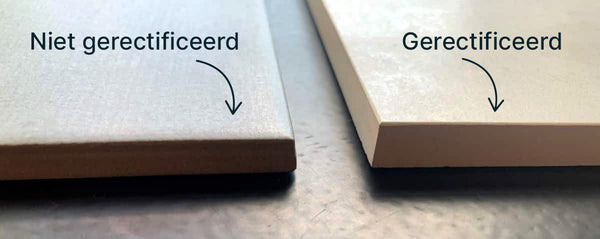
What are rectified tiles?
Rectified tiles are tiles that, after firing, have been mechanically cut to exact dimensions with straight edges. This precision allows the tiles to be laid with very small grout lines, creating a sleek and even surface.
Advantages of rectified tiles
The clean lines and minimal grout give your space a modern look. The grout lines are less prone to collecting dirt, and you can clean the surface more easily. If you want a large, seamless surface, rectified tiles are a good choice.
Points to consider with rectified tiles
They require precise installation by a professional, as any small deviation will immediately stand out. The costs may also be slightly higher due to the extra production process.
What are non-rectified tiles?
These are tiles that have natural edges as they come out of the kiln. They offer a more handcrafted and classic look with wider grout lines, which can be ideal for a homely atmosphere.
Advantages of non-rectified tiles
They are generally less expensive and more forgiving during installation, as the wide grout lines can accommodate small differences in size. They fit well in spaces where you want a more traditional or rustic style.
Points to consider with non-rectified tiles
The wider grout lines may require more maintenance and are more susceptible to dirt accumulation. If you are looking for a very sleek finish, non-rectified tiles may be less suitable.
Is there a difference in installation between both options?
Rectified tiles are produced so precisely that you should install them with a leveling system. This system ensures that all tiles are straight and at an equal distance from the wall or floor. Because non-rectified tiles are slightly less precise, you can install them without a leveling system. This method is faster and often cheaper to install. If you want a sleek and straight finish, go for rectified tiles. Keep in mind that you will have extra costs for the leveling system and possibly some extra hours for the tiler.
Conclusion
Your choice depends on your style preference, how much maintenance you want to do, and of course, your budget. Rectified tiles are perfect for a modern look, while non-rectified tiles provide a more traditional atmosphere and are friendlier to your wallet. Think carefully about what you find important so that you are satisfied with your choice in the long term.
Meer uit de kennisbank
 TegelsLes grandes dalles Floorify passent à 5,5 mm : qu'est-ce que cela change pour vous ?
 TegelsTile patterns in open spaces: tips and inspiration
 TegelsCombining Tile Patterns with Furniture: Tips and Inspiration
Liever even overleggen?
Bel of loop binnen in onze showroom in Alphen aan den Rijn.

